The power is out in Port Renfrew on southern Vancouver Island due to a cruel November storm. Pacheedaht First Nation Elected Chief Jeff Jones says there’s a lot of rain and trees coming down and they are living in darkness.
But… the chief says there is also some really good surf in his territory.
“There are big waves now here. The surfers are happy,” said Jones.
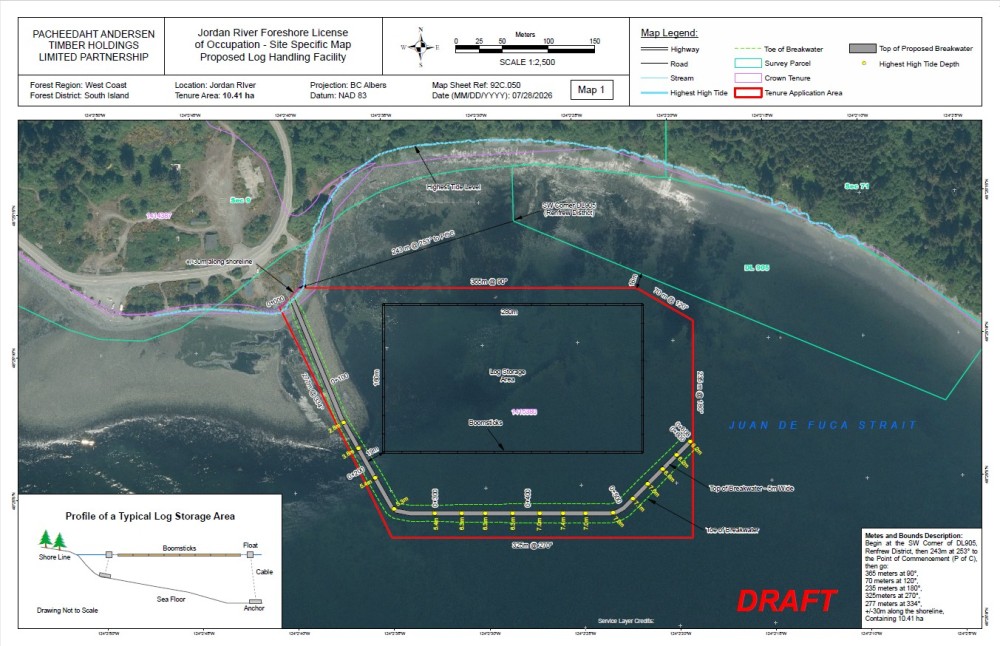
A couple weeks ago, when news broke that Pacheedaht Andersen Timber Holdings (PATH) wanted to enhance forestry operations by building a five-metre wide and 614-metre-long rock breakwater development in the surf zone, the surfers were decidedly not happy.
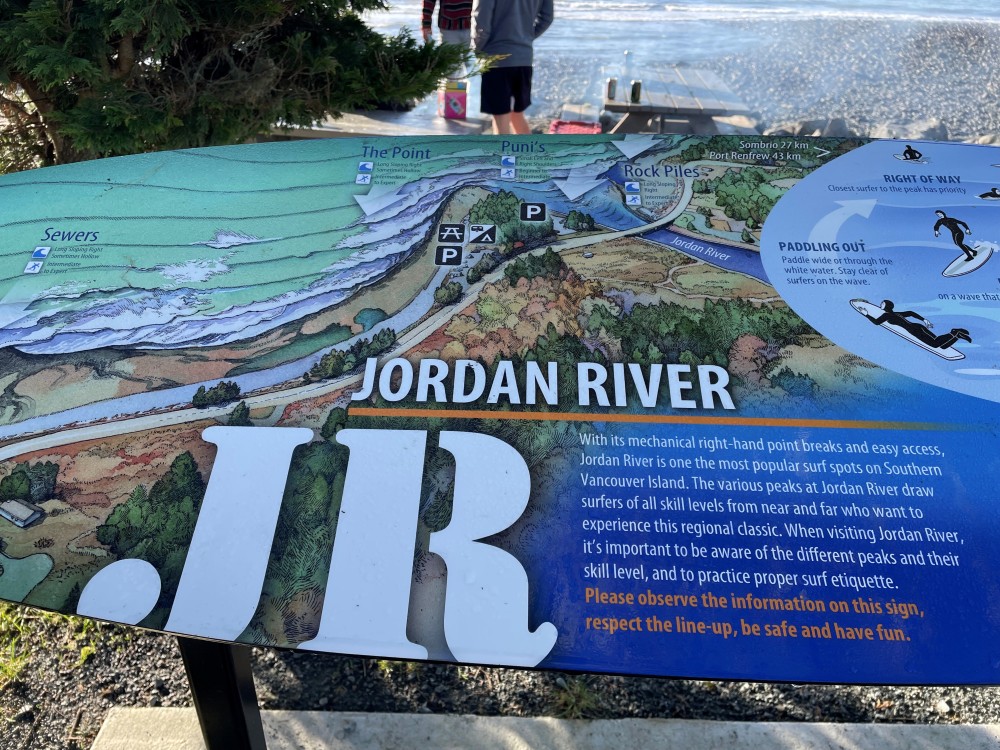
“It does pull at the heartstrings the idea that it would be gone,” said 38-year-old surfer and environmental educator Nathaniel Glickman, who lives 10-minutes from the world-class surf spot known as Jordan River or ‘JR’.
When the surf is good, over 100 recreators flood the area with surfboards, kayaks, stand-up paddleboards and hydrofoils.
“There isn’t a question within the entire surfing community that this would be devasting. It would certainly destroy two of the five waves that are right here,” said Glickman.
Public commenting was extended until Dec. 5, 2026, at 1 a.m. for the project, (File number 2026-517331), which is being reviewed by Transport Canada’s Navigation Protection Program.
Once the comment period closes, Transport Canada says they will review and consider all submissions received as part of the project assessment process. The comments will be evaluated alongside other relevant information before any decisions are made regarding the application, said Transport Canada.
As of November 13, 2026, Transport Canada said they have received 504 comments regarding the proposed Jordan River breakwater project.
Jones noted that it would take a project of this nature over five years to reach a point of community approval.
“We have a big territory. There are other areas for good surf within the territory. Concerns will get addressed by the studies that are required to happen,” said Jones.
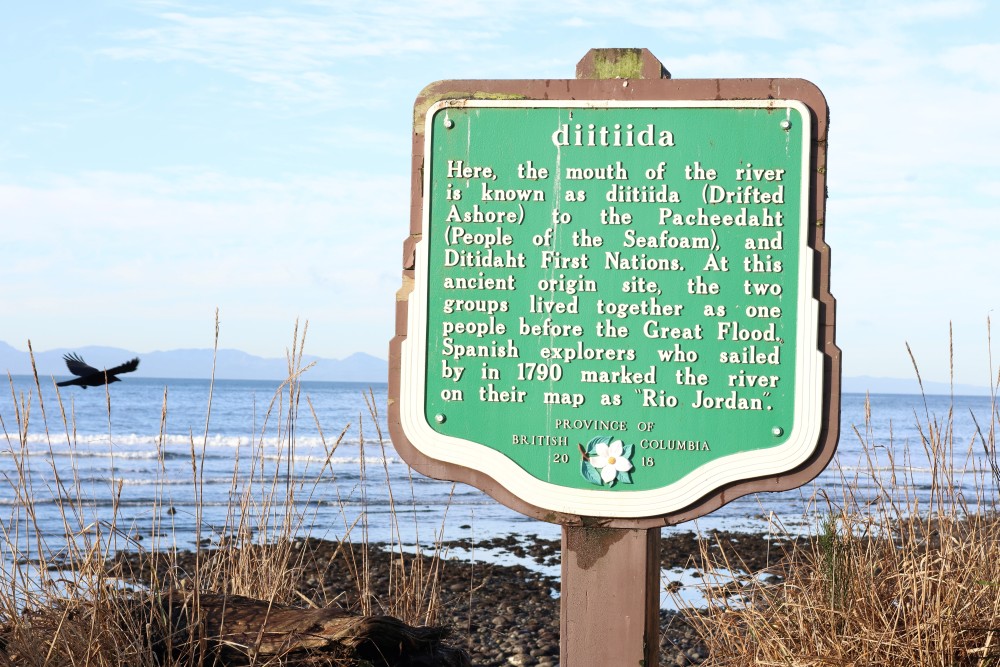
Diitiida
Located east of the Jordan River campground and in an area known locally as “Maple Bay”, construction of the proposed breakwater project would provide log storage and barge moorage for PATH, a 50-50 partnership between Pacheedaht First Nation and Andersen Timber.
PATH purchased the relatively small 20,000-hectare Jordan River Tree Farm Licence (TFL) 61 tenure from Western Forest Products in 2010. TFL 61 is managed by Queesto Community Forest, the namesake of a Pacheedaht hereditary chief.
“It was the first time they were able to re-establish some authority over the lands surrounding their traditional home at Jordan River,” said Pacheedaht forestry manager Chris Boulton.
Pacheedaht calls the mouth of what is now known as Jordan River “Diitiida”, which means drifted ashore. Diitiida was the original home to the Pacheedaht and Ditidaht First Nations, both groups are Nuu-chah-nulth people. Oral histories recount that the two nations lived together until the Great Flood. Spanish explorers who sailed by in 1790 marked the river on their map “Rio Jordan”.
Some of the survivors settled in at Whyac Village at the outlet of Nitinat Lake and became the ancestors of the people known today as Ditidaht First Nation. Some returned to the village site of Diitiida, but chief Jones shared that his people were “forced to leave” when heavy industry came along in the early 1900s.
The destructive damming, mining and forestry practices “pretty well killed our salmon resources in there”, Jones said.
“There used to be so many resources in Diitiida River you could pretty well walk on the backs of salmon,” he shared.
The Pacheedaht people ended up moving north to Port San Juan at the mouth of the San Juan River, which is now known as the town of Port Renfrew. Jones said at one point in history the population of Pacheedaht has upwards of 3,000 members, but smallpox decimated the nation to around 300 people it has today.
“We also have family connections with the Makah people across on the Olympic Peninsula side,” said Jones.
River restoration
Jones is not a surfer, although he scuba dives with his family and spends a lot of time in the water, swimming the rivers and creeks to count fish. He said while many locals call JR a “dead river”, a recent salmon escapement count conducted by Pacheedaht fisheries revealed coho, chum and sockeye in the waterway.
“We have an idea of what is trying to use that river still. It is a river our leadership would love to see that improve,” said Jones.
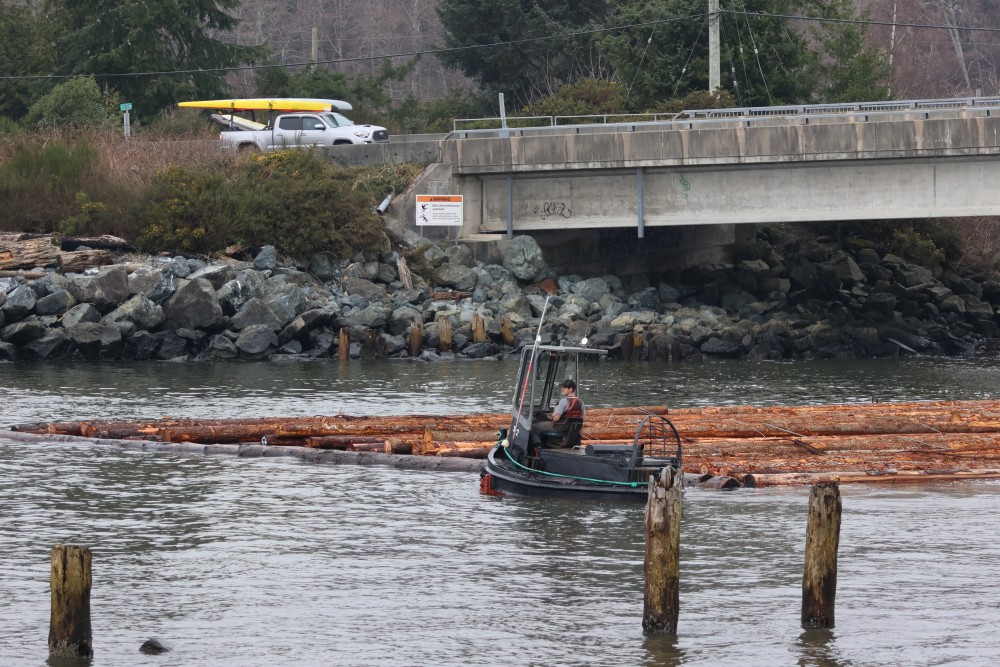
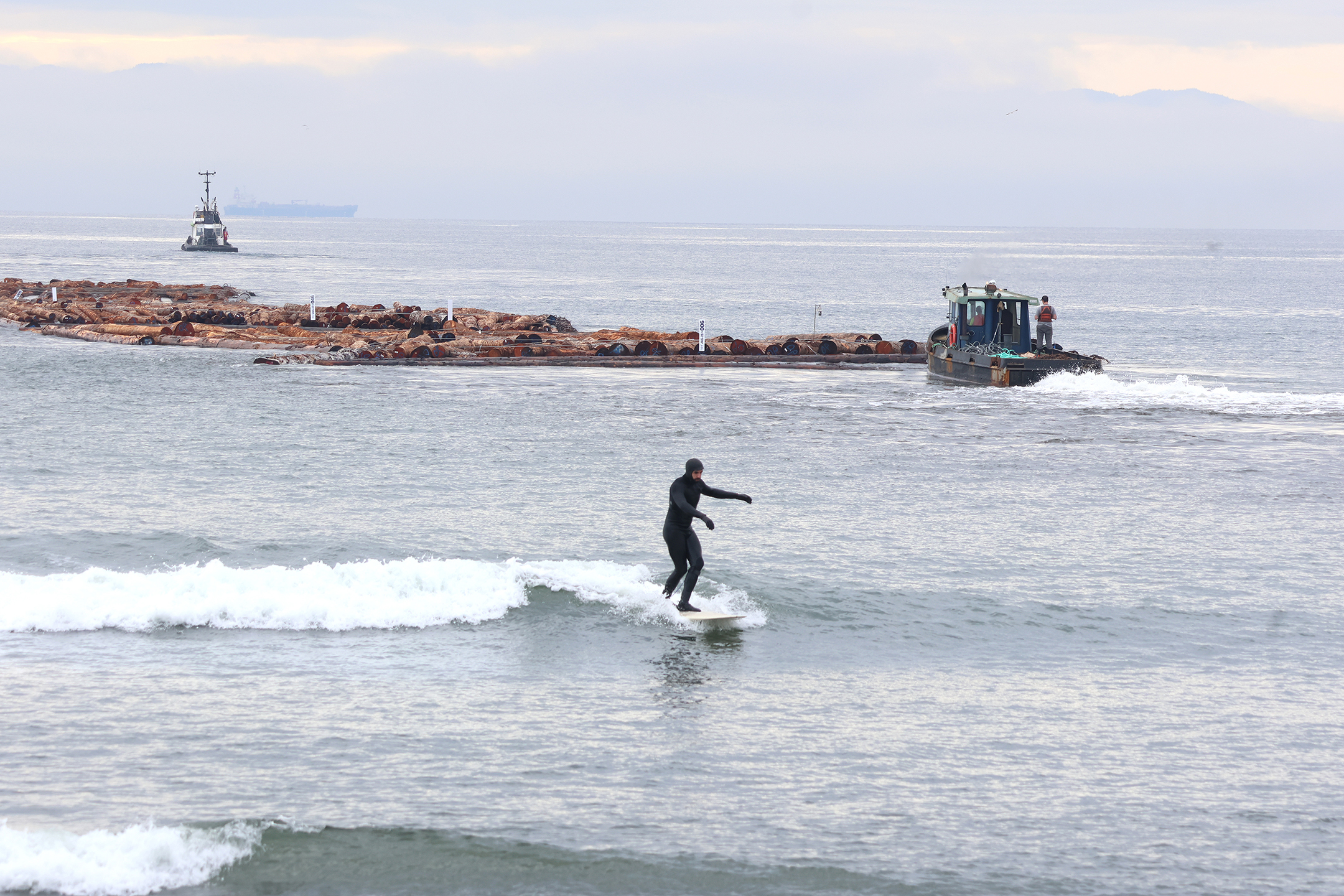
Boulton explained that the dry land log sort must use the river to build its log booms.
“When a large enough boom is built in the river, it is then towed out of the river, under the highway bridge and taken to Vancouver for sale, if the weather and tides allow,” said Boulton.
If the proposed breakwater is constructed, Boulton said it would reduce the numbers of logs and booming activity in the river, which could assist in its restoration.
“The breakwater will allow the log booms to be held out in the ocean rather than directly in the river,” he said.
But given the current dry land sort location, logs would still need to be put in the river either way as it is currently the only access to water, said Boulton.
Pacheedaht’s “ultimate goal” is to relocate the dry land sort to a plot of fee simple land located on the upland side of the highway across from the proposed breakwater log handling site, according to Boulton.
“This would remove all (PATH) operations from the Jordan River, allowing for further river restoration projects. This is the long-term vision of Pacheedaht, but it will take a long time to achieve it,” said Boulton.
BC Hydro operates a hydroelectric facility in Jordan River that is comprised of three dams (Bear Creek, Jordan Diversion and Elliott Headpond) and a single turbine powerhouse. The Jordan River system can contribute up to 35 per cent of the total hydroelectric generation on Vancouver Island, according to BC Hydro.
Sustainable timber simply
Historically, the roughly 10-hectare area of Crown foreshore that PATH is applying to lease to build the breakwater was used for log storage and was a dumping grounds for mine tailings.
Queesto Community Forest manager Angus Hope said on the low tide, you can still see where the old rock pilings used to be.
Even as B.C.’s forestry industry continues to wade through economic uncertainty, outdated forest legislation and - in some regions - a declining fibre supply, Hope says TLF 61 has a “sustainable harvesting land base”.
“We are growing more tree volume than we are cutting down and taking away,” said Hope.
In 2019, the Ministry of Forests upped the allowable annual cut (AAC) for TFL 61 to 121,000 cubic metres, an 11.5 per cent increase from the previous AAC of 108,500 cubic metres set in 2010. TFL 61 includes 6,151 hectares of forest more than 240 years old. Of this old forest, 2,902 hectares are within the timber harvesting land base, according to the ministry.
“Over the next 30 years, that cut could actually in theory go up because there will be more and more (trees) going online to be timber. We have more trees there today than when we started 16 years ago,” said Hope.
Pacheedaht forestry representatives say the proposed breakwater would also reduce navigation risks within the Strait of Juan de Fuca by significantly cutting down the number of tugboat trips from Jordan River to Beecher Bay.
Fisheries and Oceans Canada is also involved in the application and will examine the impacts the development would have on fish habitat.
Glickman points out that JR is a “high-energy environment”, with big storms carrying 15-foot waves that would smash directly into the log-holding structure, breaking booms loose and creating navigational hazards.
“The chances of (the breakwater) being able to withstand the swell that we get here is pretty grim,” he said.
Glickman thinks the future of south Vancouver Island is tourism, not forestry, and that the recreational community would rally around any Pacheedaht-led business.
“We completely understand the need for Pacheedaht to make revenue off their territory. We just think it’s crazy to destroy this natural resource that exists here,” said Glickman.
He suggested spending the proposed breakwater money on building another mill to process the timber locally or implementing a recreation permit program like the one Makah Tribe in Neah Bay, Washington has.
“People want to be part of a sustainable solution that makes sense in the long run,” he said.
Pacheedaht currently owns and operates a small mill in Port Renfrew. Jones says the mill processes old-growth cedar and creates employment and revenue for his people. He said mill revenues built the Pacheedaht PitStop, a much-needed gas station…that all the surfers use.