
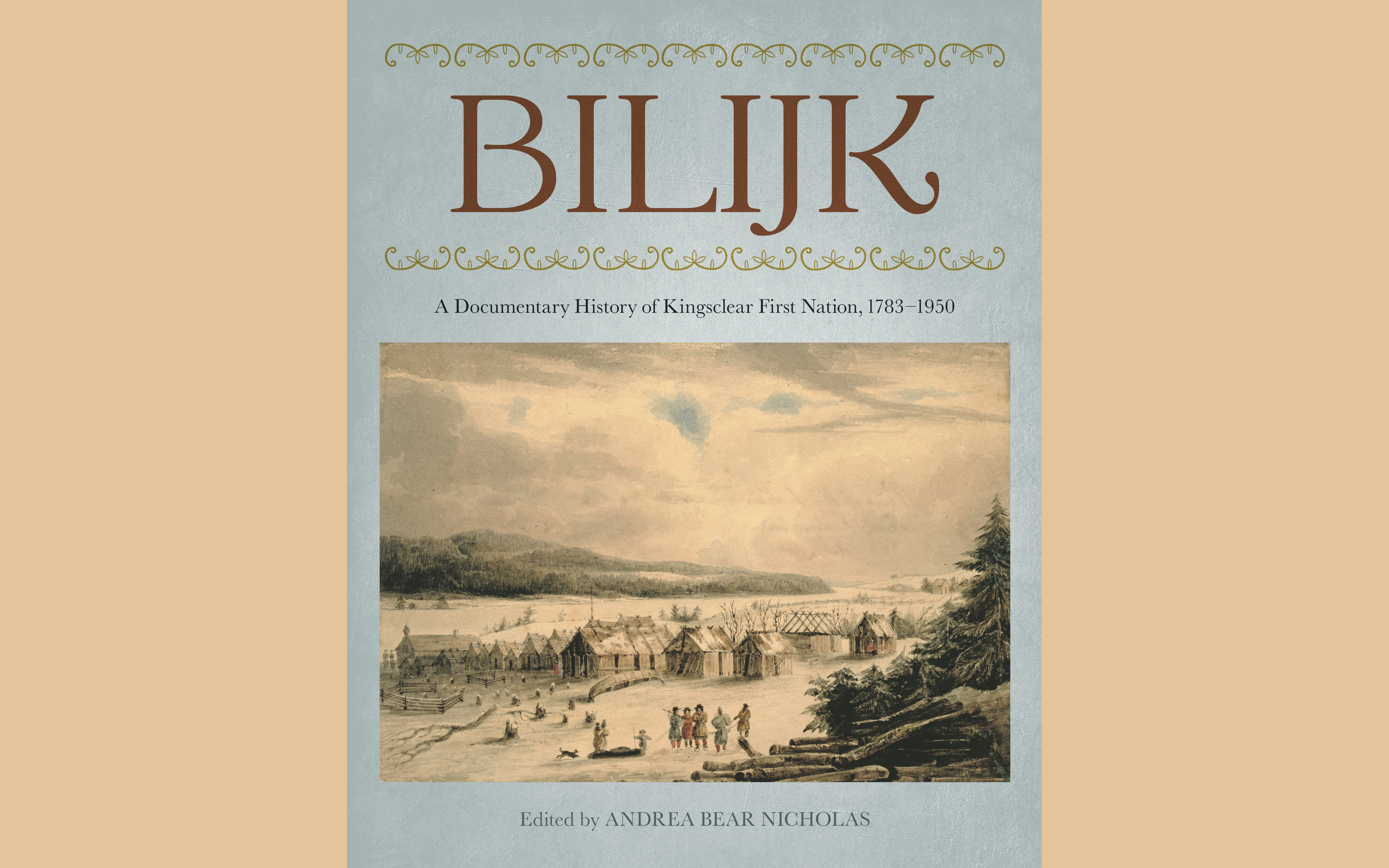
In this beautifully presented but shocking history of settler colonialism in a small First Nation community, Kingsclear - now known as Bilijk, New Brunswick - Andrea Bear Nicholas tells an explosive tale of land theft, violence, forced assimilation and cultural genocide – and, despite all, the survival of an unwavering people.
Through contemporary oral histories, archive documents, paintings, maps and photographs, professor Bear Nicholas, who is Wəlastəkwew (Maliseet) from the nearby Nekwətkok (Tobique First Nation), comprehensively documents the history of the first Maliseet community to be established by the Canadian government as a reserve.
As Nicholas explains, the land that became the first Kingsclear reserve was set aside for the Maliseets by the British of Nova Scotia twice: first in the 1760s, and second in 1779, during the American Revolution, when authorities promised the land to two Maliseet chiefs in return for their support of the British over the Americans.
On banks of the lower Wəlastəkw (Saint John River), the Kingsclear reserve was continually reduced in size by the authorities, swindled away from the community through lies, deception and sales that vastly undervalued the highly fertile land.
Like so many other Indigenous communities across Canada, before colonialism the Maliseet had lived a rich, plentiful life, hunting moose, deer, and caribou, and fishing for salmon with spears and torchlight. And like so many other Indigenous communities, these traditional practices were systematically eradicated, firstly through forcing of agriculture upon the Maliseet, and later through the passing of laws restricting or forbidding traditional food-gathering practices.
When the New Brunswick authorities enacted a complete ban on hunting moose in 1937, Bear Nicholas explains that such laws pushed even more Maliseets into the working classes of settler society, as farmhands, mill and domestic workers.
“With the Maliseets no longer surviving by traditional means, anthropologists were quick to capitalize on the situation by buying up treasured Maliseet cultural artifacts for a pittance,” she writes.
Many photographs of these stunning cultural artifacts - birch bark canoes, baskets, bead work, wampum belts and much more - grace the pages of this book, alongside official church records of marriages, baptisms and funerals among the community.
In all the archive material, which Bear Nicholas presents chronologically, any offensive language is kept intact “in the interest”, as she writes, “of conveying the true attitudes of the time.” These archival texts, alongside letters, laws and many contemporary photographs (some from as early as the 1850s), vividly depict the daily life of the Kingsclear First Nation over the centuries.
The Catholic Church first began educating Kingsclear children in the 1850s, but as Bear Nicholas writes, this accelerated with the building of a day school on the reserve in the early 1880s.
“The goal this time was not only to educate children in the knowledge and customs of the settler society, but also to wipe out Maliseet, the language that connected Maliseets to the land and their traditional form of life.”
When the residential school at Shubenacadie, Nova Scotia was opened in 1929 (the only residential school in the Maritimes), some Kingsclear children were sent there in the 1930s and 1940s - over 400 kilometres away from home.
Today, Kingsclear has approximately 981 members, with 692 residing on reserve, which is located 15 kilometres west of Fredericton, New Brunswick. The on-reserve Wulastukw Elementary School was built in 1995 and currently has a student population of 55.
Bilijk: A Documentary History of Kingsclear First Nation, 1783-1950 by Andrea Bear Nicholas is available for purchase at Goose Lane Editions. A Maliseet edition of the book (Pilick: Kekw Kisowikhasik ’ciw Pilick təkkiw 1950), is also available.


