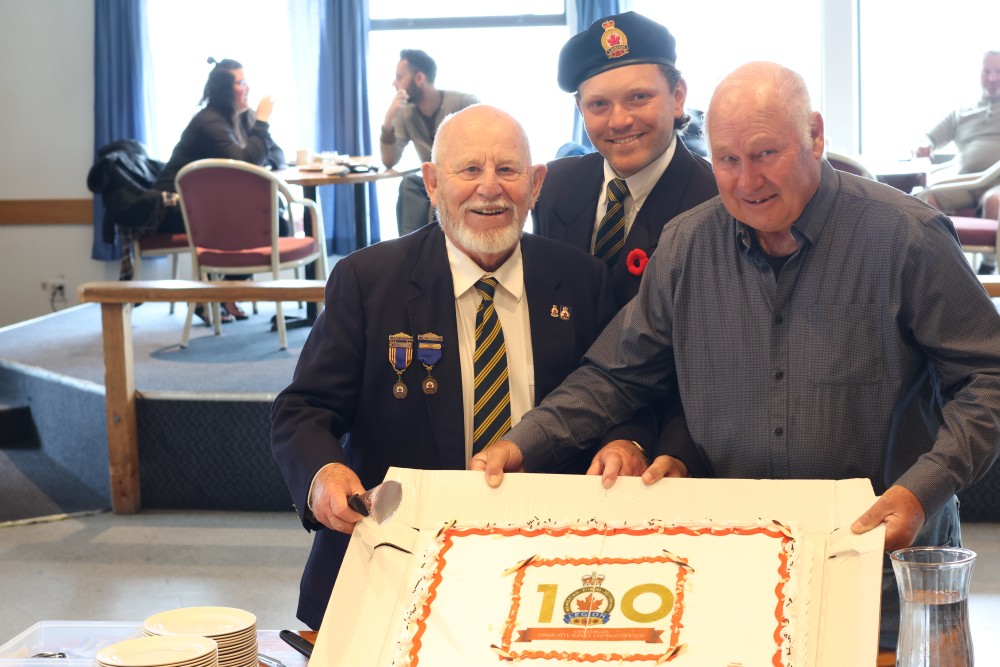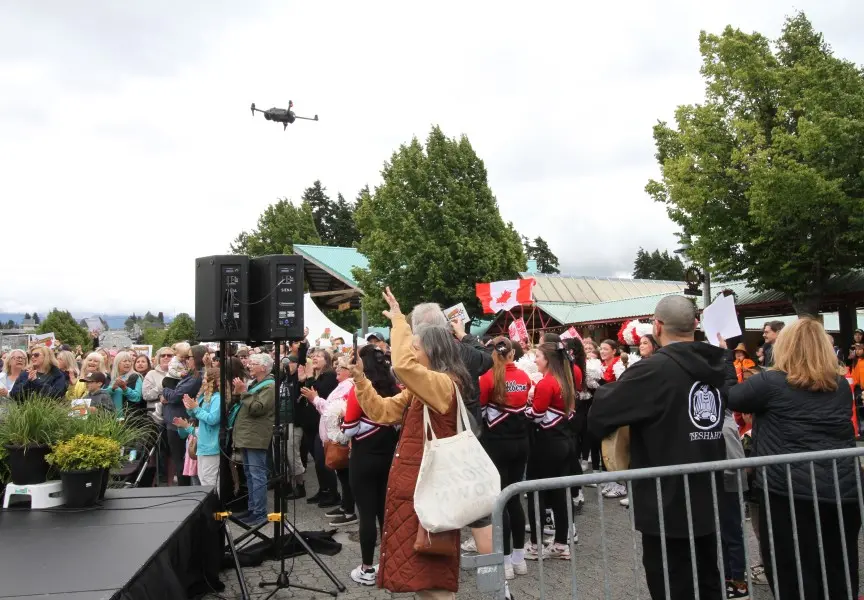
The Royal Canadian Legion Branch No. 65 in Tofino, B.C. marked its 100th anniversary with a pancake breakfast and cake-cutting on July 17.
The organization that is now the Royal Canadian Legion was started by the veterans of the First World War to support those who served in the conflict, advocate for their rights and preserve memories. It was formally incorporated by a Special Act of Parliament on July 17, 1926. Tofino’s branch actually pre-dates the Legion’s official birthday and is one of the earliest established veterans’ hubs in Canada.
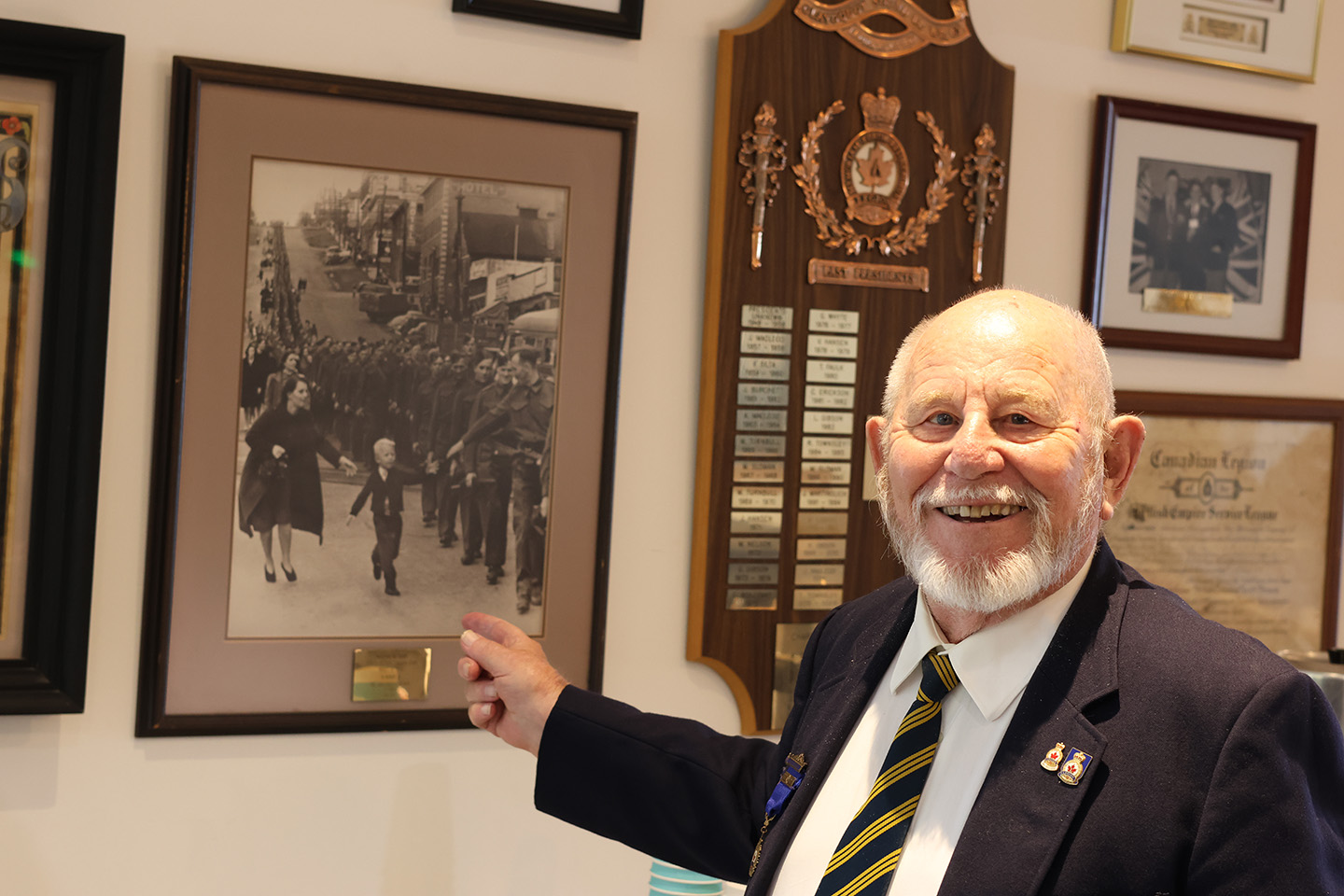
Warren “Whitey” Bernard, past-president of the Tofino branch and a lifetime member of the Royal Canadian Legion, gave a heart-warming toast to the organization.
The 91-year-old was the famous little boy reaching for his father’s hand, Sergeant Jack Bernard, in the iconic 1940 “Wait for me, Daddy” photo by Claude P. Dettloff.
“This legion was built when this little village was only connected to the outside by steamship. Before the road, Tofino had its legion,” said Bernard.
“When I came to this town, flat broke by the way in a turmoil, the first place I arrived was of course the Maquinna Hotel for one night. But then we found the Legion, and that was a gem. We met the real people of Tofino. That’s where you came when you wanted to behave yourself, when you wanted to meet the backbone of this community,” he said.
In 2019, the Tofino Legion fell under hardships and closed its doors. It didn’t reopen until October 2023.
“We damn near lost it,” said Bernard.
But he said the younger generation like his grandson Riley Banks, 24, have stepped-up to bring the Tofino Legion back to the community hub it once was.
“We want to try make things as good as we can for the community at large,” said Banks, Tofino Legion vice-president. “We are here to support the entire West Coast.”
“We are always looking for volunteers and anyone who has ideas on how to best support the community,” Banks continued.
Tofino Mayor Dan Law attended the Tofino Legion 100th birthday celebration. Law shared that his late dad Bruce Law was in the Canadian Navy and received the Meritorious Service Medal. He said his grandfather was also in the British Merchant Navy and all his great grandfathers were in the First World War.
“The war generation is dying. There are only a handful of veterans left. Hopefully we don’t have another war, but it’s right at our doorstep, we are one step away; Article 5 would draw us in,” said Law.
Article 5 of the North Atlantic Treaty (NATO) states that an armed attack against one NATO member shall be considered an attack against them all.
Over the next decade, the Government of Canada plans to invest half a trillion dollars on defence – from submarines and aircraft to drones, sensors, and radar systems, according to an announcement released March 26 by Prime Minister Mark Carney.
According to Veterans Affairs Canada, over 12,000 of the country’s Indigenous people served in the 20th century’s conflicts, with at least 500 losing their lives. Over 20 Nuu-chah-nulth-aht have fought for Canada and the United States in wars, according to a list compiled by Ha-Shilth-Sa.
But historically, Indigenous soldiers who served in the Canadian military were often treated unfairly compared to other veterans when they returned home from war. Most First Nations veterans were unable to receive full supports, grants and benefits due to their legal status under the Indian Act.
It wasn’t until 1951, when the Indian Act was amended, that an Indigenous veteran could share a toast honouring lost comrades in a Royal Canadian Legion hall.
Gary Peters sits on the Legion BC/Yukon Command Executive. He said the Legion had to live by government law at the time to remain open.
“The Legion was one of the “leading voices” calling for reform of the Indian Act so Indigenous veterans could enjoy the same rights as other veterans. They served, they sacrificed, and they died equally, but when they came home they couldn’t even have beer anymore,” said Peters in a written statement to the Ha-Shilth-Sa.
“Men who fought together should be able to gather together was the legion mantra at the time,” he continued.
Between 1946 and 1948, a Special Joint Committee of the Senate and House of Commons was tasked to review the Indian Act. The Legion made representations to this committee.
“Their recommendations were that Indigenous veterans receive the same treatment and rights as all other veterans, that included equal access to veterans’ benefits, removal of legal barriers preventing participation in Legion services, and elimination of discriminatory provisions affecting returned servicemen,” said Peters.
“It is my earnest hope in the next 100 years we are all able to live and gather together while enjoying all the same rights and freedoms that all of our veterans fought and many died for,” he said.