More than 1,200 responses have been collected so far for a long-form survey, part of a larger, multi-year project aimed to give Nuu-chah-nulth nations a clear picture of the health of their communities.
The online survey for the Hishuk-ish tsawalk Healthy Children, Healthy Futures research project will be open until Dec. 10 for Nuu-chah-nulth people, as well as others who live on the First Nations’ reserves or treaty settlement lands. Launched by the Nuu-chah-nulth Tribal Council in December 2025, the survey takes 30 to 60 minutes to complete, covering a range of topics that include health conditions, physical activity, social connections, traditional food, income, housing, diet and approximately 50 different diseases. The survey is intended to measure the overall health of a community, identifying factors that support well-being and contribute to illness.
Serene Kerpan is the NTC’s research associate lead for the project. She is hoping for 1,500 survey responses, and to gather more participants her team plans to host a table at the upcoming urban holiday gatherings in early December, as well as a session at Simon Fraser University in Vancouver.
“We need a certain percentage of some of the questions answered, and a certain percentage of some of the most important questions answered,” said Kerpan. “The goal is to be finished by the holidays and have some data for the nations and for the tribal council in the new year.”
The survey is part of a larger research project that began in its early stages in 2017. Funded by the Canadian Institutes of Health Research, the project has been guided by close consultations with Nuu-chah-nulth-aht. Results of the survey will be provided to the 14 participating Nuu-chah-nulth First Nations once the main findings are determined in 2027.
“It gives us a chance for the nations to lead analysis, as well as receive findings right away,” said Kerpan.
Consultations with Nuu-chah-nulth over the years have steered the project into questions around mental health, substance abuse and cardiovascular disease. But the study also aims to find out more about what could be supporting wellness in Nuu-chah-nulth communities by asking about the role of Indigenous culture and traditional food, like wild salmon, in people’s lives.
“Asking about traditional food, asking about community and family networks, those are all really important links to health and I think they’re opportunities for us to see where things are going well,” noted Kerpan.
In January the Healthy Children, Healthy Futures project launches an intensive study of young Nuu-chah-nulth families, starting with pregnancy and extending to a child’s age of two.
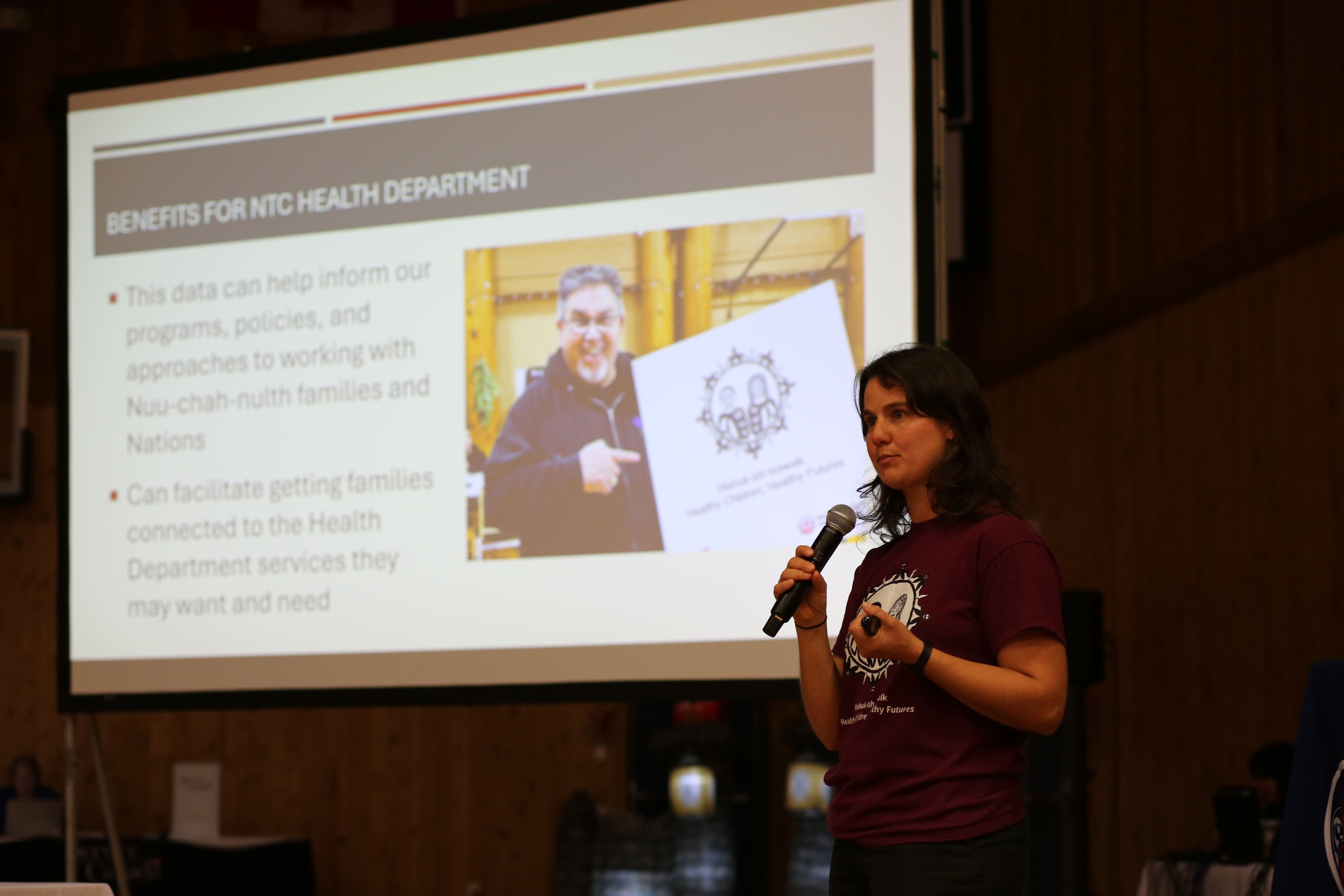
“We’ll be inviting parents who are pregnant, the partner of someone who is pregnant, or anyone who has a child under the age of two years old,” said NTC researcher Sierra Boudreau during a presentation of the project at the Health-Ability Fair in Port Alberni on Oct. 28. “What happens in utero and in the first two years of life affects your health and well being for your entire trajectory.”
“The information and support that parents and babies will receive as part of this project may help them in starting life in a good way, leading to health across the lifespan for Nuu-chah-nulth children,” stated a description of the long-form study.
The research project aims to look deeper than other health studies that have painted a grim picture of First Nations, such as a wide-ranging report released by the First Nations Health Authority and the Provincial Health Officer in 2024. This health update indicated a diabetes prevalence of 8.5 per 1,000 among status First Nations in B.C., compared to the 6.4 rate for others that was tracked in 2021. In the report avoidable hospitalizations – which are incidents that could otherwise have been prevented through adequate primary care – affected First Nations at a rate of 72.6 per 10,000 annually in 2022, compared to 20.3 for others in B.C. Serious injuries were also higher among First Nations in that year, with a rate of 3.1 per cent compared to 1.3 per cent for other B.C. residents. Healthy birth weights were also less common among First Nations at a rate of 72.1 per cent – 10 points lower than others tracked in 2019.
Kerpan hopes that the upcoming family study can take a more positive approach.
“One of the things we are hoping for is that communities and families see the value in this study and see something that is celebrating families and births in communities, and a way to understand what a good life is from the get-go,” she said.
A critical part of the project is building trust with Nuu-chah-nulth families. Researchers are well aware of the lasting effects of the “bad blood” scandal, in which over 800 samples were taken from Nuu-chah-nulth-aht in the 1980s with the promise of finding a better treatment for rheumatoid arthritis. But it was later discovered that, without their knowledge or permission, these blood samples were taken to the United States and elsewhere to be used in genetic anthropology studies.
“We know that this data is sacred, it’s sensitive, and there’s been a very recent history of poor, awful health research done with these communities,” said Boudreau.
The Healthy Children, Healthy Futures project also involves Cree and Dene nations from northeastern Alberta, as well as the Cree Nations of Maskwacis.
“We meet monthly with them,” said Kerpan. “We talk about what measurements we’re using, what engagement processes and strategies we’re using.”
Besides the NTC researchers, other work on the project is being undertaken at SFU’s Faculty of Health Sciences and at the University of Alberta.
In late 2022 the entire multi-province project received a $16 million grant from the Canadian Institutes of Health Research. This is expected to last for four more years, at which point the NTC hopes to keep the study going with another round of funding.
“We’re hopeful with the good work we’re doing in collaboration with communities that we’ll be re-funded and this will become a really significant long-term study for NTC,” said Kerpan.