
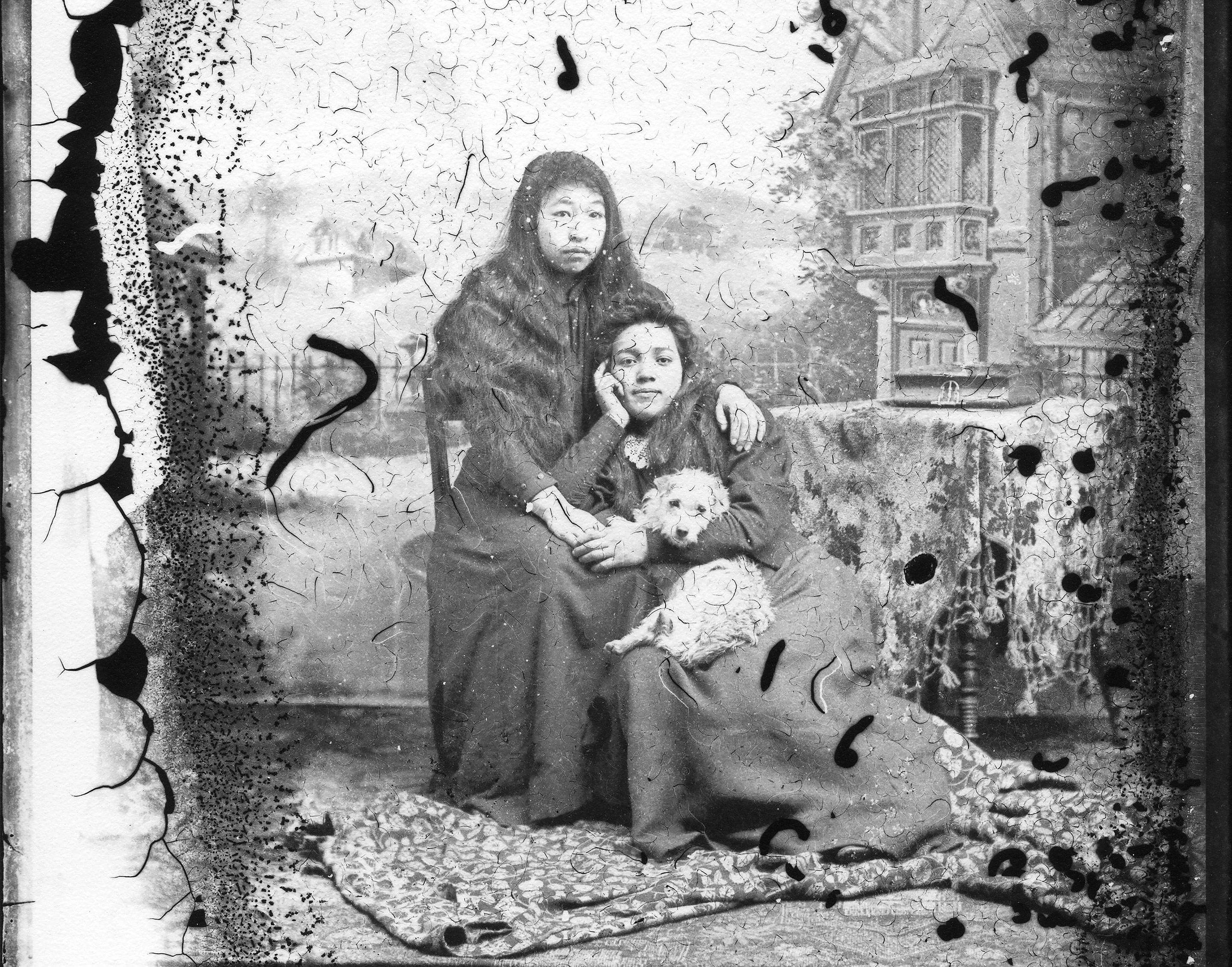
History tells us that First Nations people in the Americas kept dogs long before colonization. There were guard dogs and hunting dogs. But there was one that was so special that it was carefully bred, fed higher quality food and protected from other dogs.
The Woolly dog goes by other names, like the Salish Wool Dog, the Comox Dog or Clallam Indian Dog. Now extinct, it was bred for its long white hair, used in woven blankets and clothing.
The Woolly dog was small to medium in size, usually white with a thick undercoat prized by weavers. They were carefully tended, washed and shorn up to three times a year.
Woolly dogs were prized and would have likely been owned by high-ranking families in First Nations communities throughout the Coast Salish territories, including on the southern end of Vancouver Island, the Strait of Juan de Fuca, Puget Sound, the Olympic Peninsula, the Salish Sea and the Lower Fraser River.
In 2019 a Woolly dog skull was unearthed during an archaeological dig at Keith Island, proving that they existed in Tseshaht territories, as far north on Vancouver Island as Barkley Sound.
Because they needed to be isolated from other dogs to prevent interbreeding, sometimes a pack of the special dogs would be placed on small islands in the spring and summer. Back in the village, they would have been ‘inside dogs’, allowed to stay inside the house with the owners while the other dogs stayed outside.
“Prior to the arrival of Europeans, there were several types of dogs in the Pacific Northwest: larger ‘village’ dogs and hunting dogs and small Woolly dogs, kept separately to prevent interbreeding,” states a Smithsonian Institute article.
It goes on to say that the Woolly dogs were a little larger than the modern American Eskimo dog breed and had curled tails, pricked ears and a pointed fox-like face. Instead of barking, they howled.
Once shorn, the hair would be cleaned, processed, then mixed with mountain goat hair, waterfowl feathers or plant fibers to be spun into yarn. The yarn would then be used to make blankets and clothing. Gifts made from Woolly dog hair were highly prized for potlatches.
When the Pacific Northwest became colonized, several factors led to the demise of the Woolly dog. Introduced diseases decimated Indigenous populations. Government assimilation policies like those implemented in Indian residential schools and potlatch bans meant the art of weaving was practiced less. The introduction of cheaper, manufactured blankets meant there was no longer need for the labor-intensive work of making yarn from Woolly dog hair.
No longer prevented from breeding with other dogs, the Woolly dog, as a distinct breed, became extinct in the late 1800s.
In the mid 1800s a Woolly dog was obtained by naturalist George Gibbs and was named Mutton. It is believed Mutton was acquired in what is now the Chilliwack area, and only lived for 18 months. Research shows that he had been shorn at least once in his lifetime.
It is not known how Mutton died, but Gibbs’ journal indicates that Mutton had gotten ill shortly before his death.
Following his death in 1859, Mutton’s pelt was collected and donated to the Smithsonian Institute where it remained for about 160 years – the only known Woolly dog pelt in existence.
Jordan Wilson is the University of British Columbia’s curator for Pacific Northwest and Contemporary Indigenous Art and he is a member of the Musqueam Indian Band.
Wilson knows the weaving history of his people and says that the art is making a resurgence. The Woolly dog, he said, is an important part of that history, making it more exciting that the pelt, in storage for more than a century, has been loaned to the UBC Museum of Anthropology where it will be on display for one year.
Wilson said this is the first time the pelt has come back to Canada and so close to the region where originated.
The Woolly dog, said Wilson, is deeply connected to a challenging history. It is extinct, he said, as a direct result of colonialism and the disruption of culture, like the potlatch ban.
“This is the only known example of fur of this dog, so this is a special opportunity for this museum to host it here for a year,” Wilson said.
Having the pelt in Musqueam territory makes it accessible to weavers of the region and other community members.
“It will educate the public on this remarkable history,” said Wilson.
On Friday, September 4, the MOA hosted a community access visit as the pelt was removed from shipping containers.
“We had about 40 people or so from Vancouver Island, the Fraser Valley, Vancouver region who came to spend time with pelt before it was put into display case for the year,” said Wilson.
He noted attendees were allowed to touch the pelt with gloved hands prior to its placement in a display case. It is important for them to feel the fibres that their ancestors worked with, said Wilson. They had to wear gloves because of the 1800s chemicals that were used to preserve the pelt.
During its time at the MOA, Wilson expects elders and weavers to visit.
“An important component to borrowing this pelt is to have weavers and community members from different nations sharing teachings weaving around the Woolly dog,” said Wilson.
The idea is to promote cultural sharing, and to hear different voices and perspectives.
Despite the history of disposition and assimilation, Wilson is pleased to report that the art of weaving endures, and knowledge of these dogs continues to this day.
“Even though this dog no longer exists our people still carry forward its history and importance,” said Wilson.
The pelt will be on loan from the Smithsonian Institute’s National Museum of Natural History to the Museum of Anthropology (MOA) from Sept. 4 to August 2027.
MOA sits on the traditional, ancestral, and unceded territory of the Musqueam people. The loan follows a request from Stó:lō leadership, in whose territory it is believed the pelt originated from. Due to conservation and security requirements, the MOA is the closest it can come to its home region while remaining accessible to Indigenous communities.


