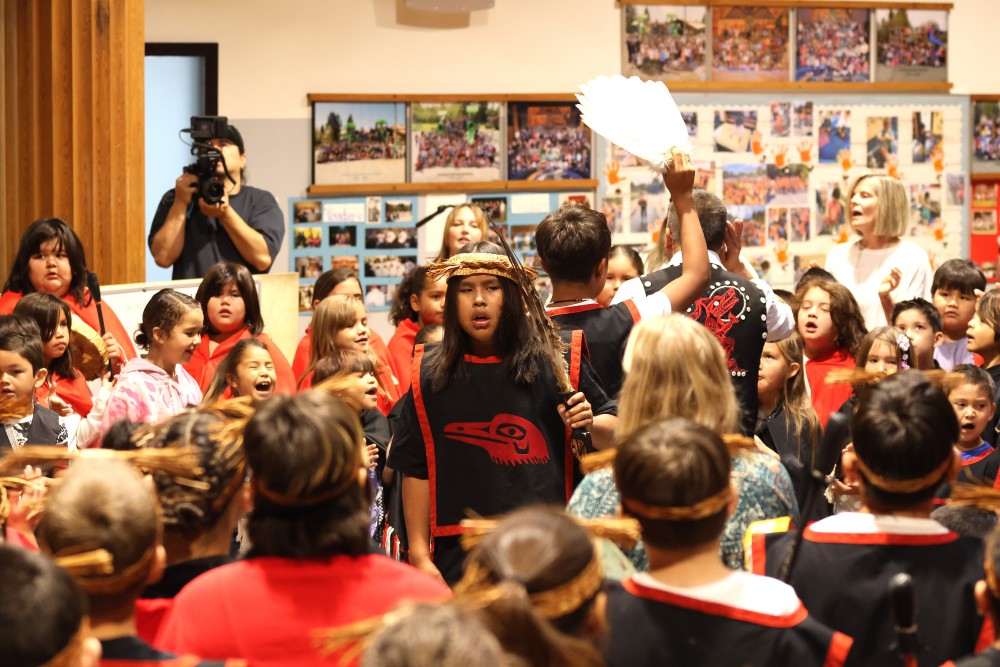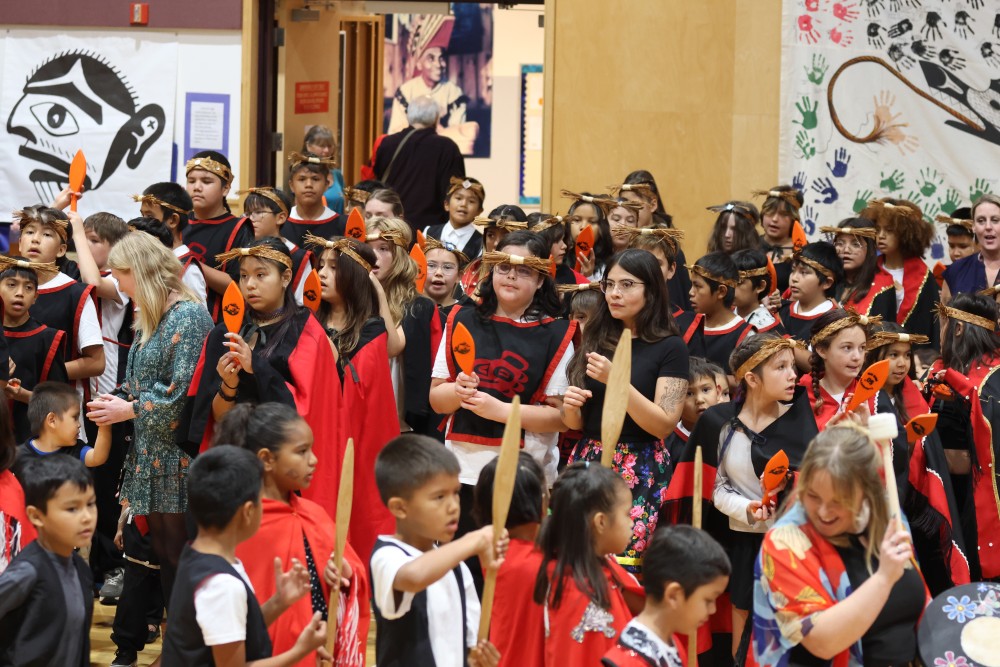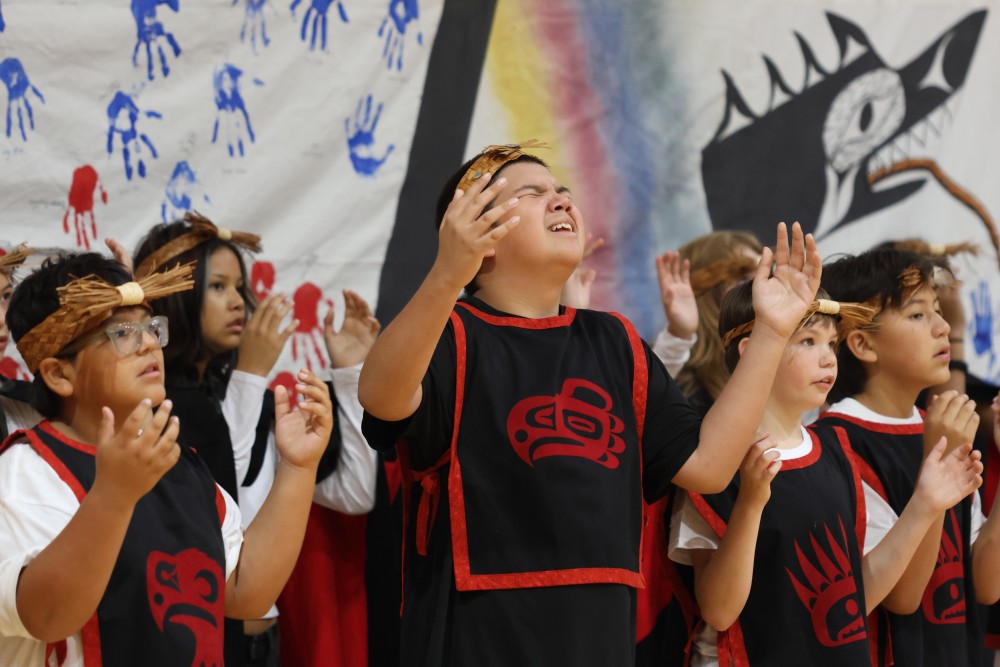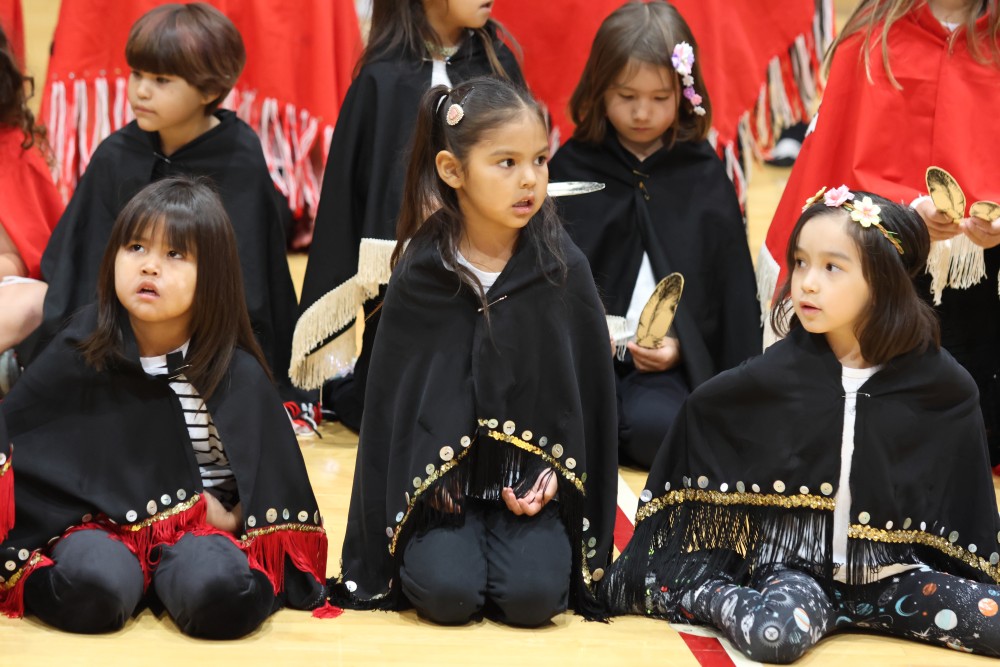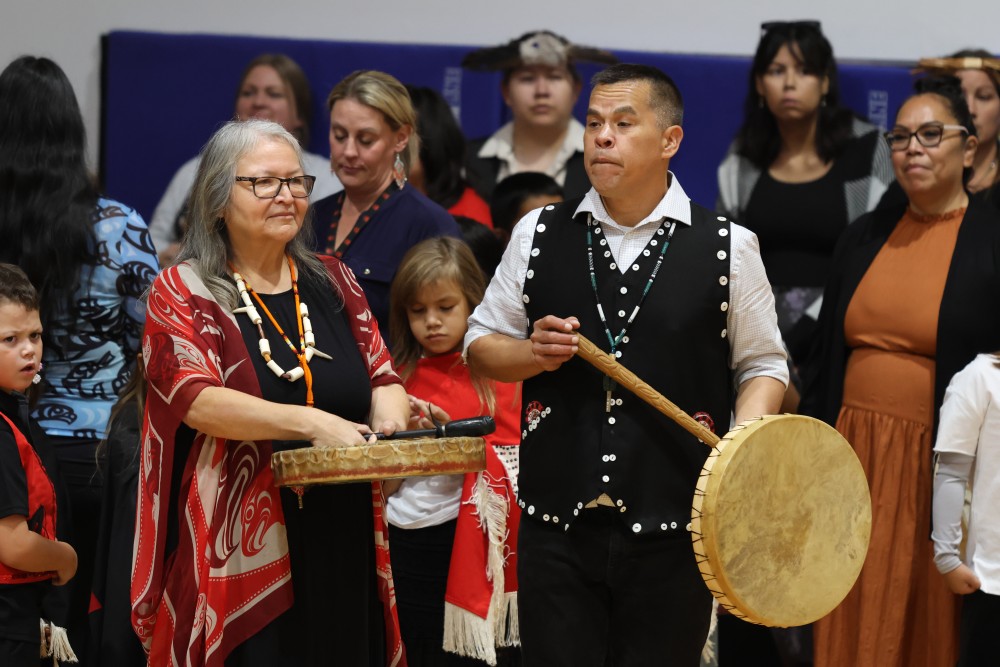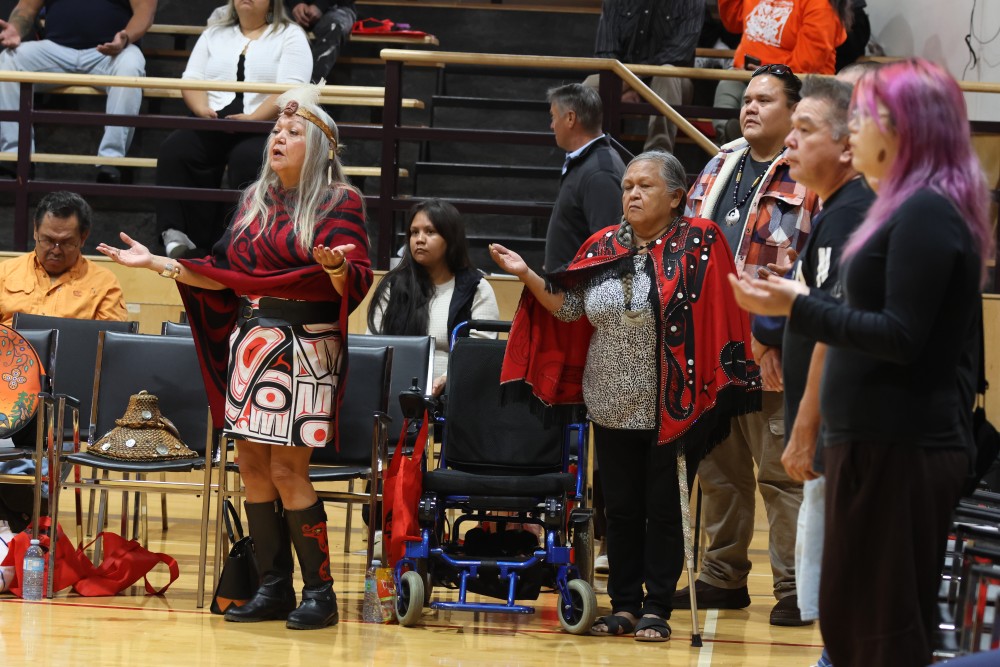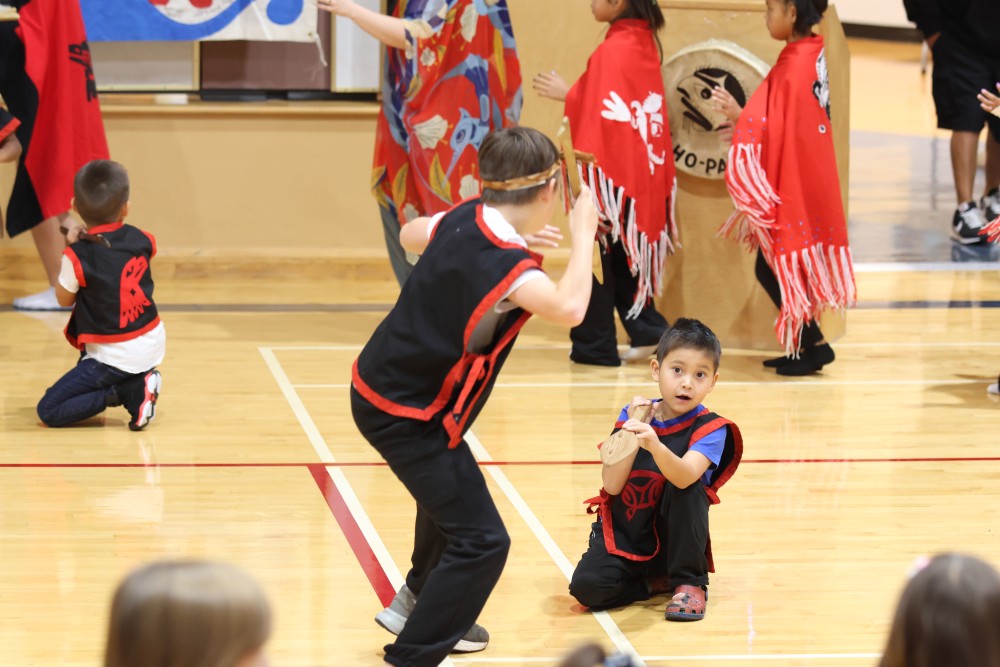
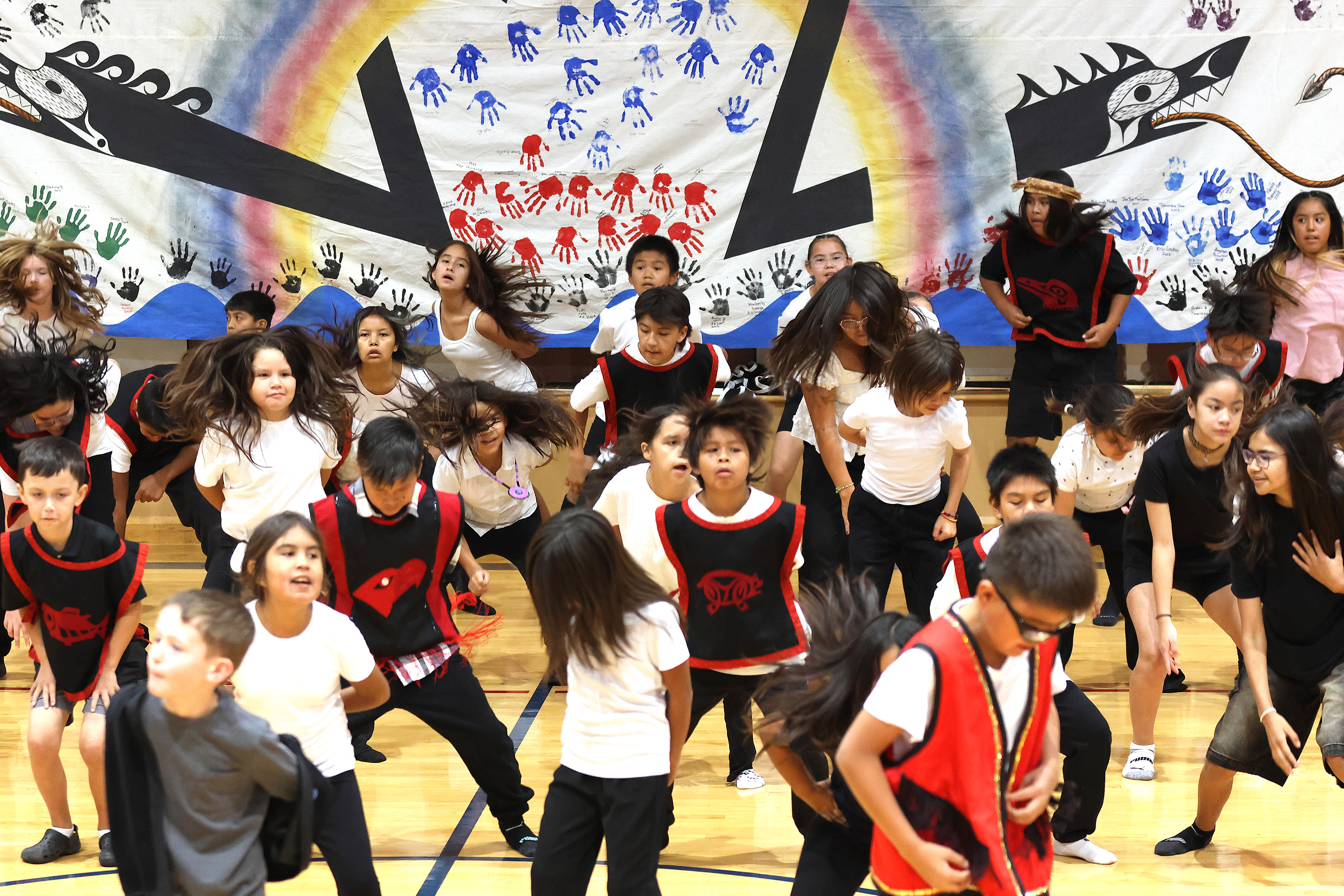
Wearing little light-up sneakers and shawls trimmed with silver and gold sequins, Haahuupayak Elementary School students sparkled with the spirits of their Ancestors as they performed the War Song on Oct. 8 for the 50th anniversary celebrations.
Event co-emcee and cultural educator Trevor Little told the audience that nowadays, the War Song is preparing the children for another battlefield.
“It’s for your education; it’s for your life,” said Little. “And we want to acknowledge the battles that got us to where we are today.”
Founded in 1976, Haahuupayak, of the root haahuupa, which means “teaching with love” is a Nuu-chah-nulth school located in the Alberni Valley on Tseshaht First Nation reserve land. Today, the independent school has an average student enrolment of 155 and delivers the B.C. curriculum to its Kindergarten to Grade 7 – plus facilitates a Nuu-chah-nulth language and culture program.
Richard Watts is one of the five original board members of the Haahuupayak Society.
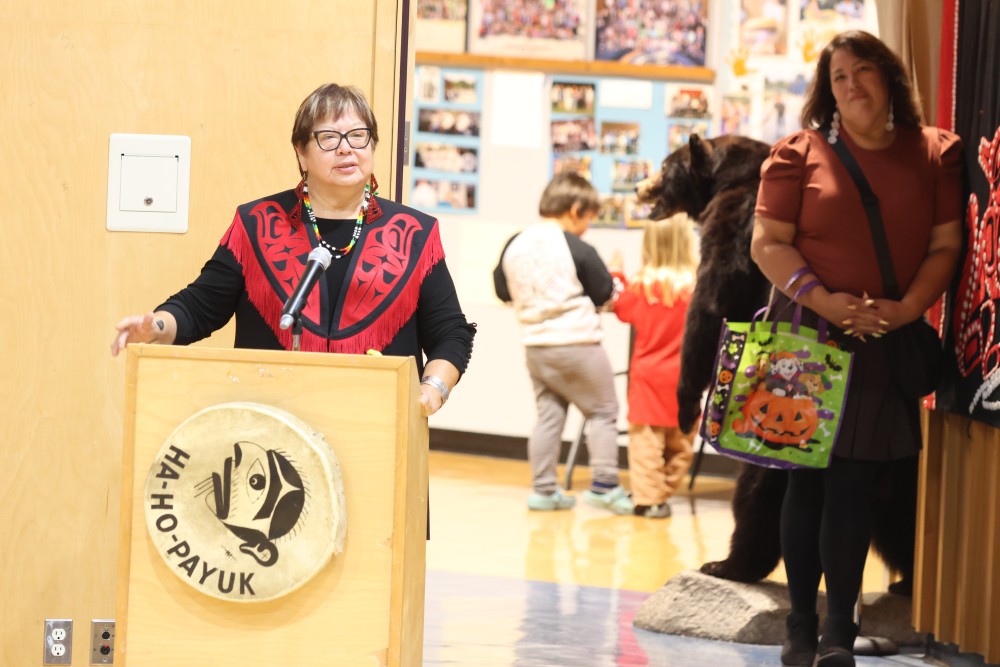
“It’s been a great journey. Our kids weren’t finishing school, they weren’t being treated fairly, and we wanted to do something about that,” said Watts during the Oct. 8 festivities at Haahuupayak gymnasium.
“One of the things that residential schools did was to try to take the Indian out of the child, as it were. They worked on lowering our self-esteem about who we were and where we came from. That was one of the challenges we took on, and I have to say, it’s been really successful. Watching those kids this morning, watching the songs they sang, we succeeded in overcoming that,” he said.
Tseshaht chief councillor Wahmeesh (Ken Watts) spoke to the crowd as the late George Watts’ son. George was instrumental in building Haahuupayak School. Wahmeesh shared he was brought to tears as he walked into the school lobby for the celebrations; he said he could feel the spirits of those who were no longer with us.
“My late date would be really proud of where this school is going and where they are right now,” said Wahmeesh.
“It wasn’t that long ago that we had a residential school in our backyard. Just over 50 years ago there was a school that operated here and was shut down. My dad would always say the (elders) gave us direction to help build this school,” he continued.
Wahmeesh attended Haahuupayak from Kindergarten to Grade 3 when it was run out of the old Caldwell building. His son also attended Haahuupayak from Kindergarten to Grade 7.
“For a school that was completely underfunded for a very long time, it was able to do amazing things with the resources that they had,” he said.
Twenty-years ago, the Haahuupayak Society raised enough funding to build the new school on Tseshaht lands at Santu Drive and Mission Road. Wahmeesh shared that the project was the largest Tseshaht has ever done to date and that it employed the most Tseshaht members.
“I just want to acknowledge all those who not just pushed to get this building built but who actually put their blood, sweat and tears into building it and maintaining it,” said Wahmeesh.
“I think my dad would want to thank these teachers,” he continued. “There isn’t a staff member, past or present, that came here for the money. None of them came here for the money, they came here because they cared about the work. On behalf of all the parents and grandparents here we say thank you, thank you for caring for our children.”
Nuu-chah-nulth Tribal Council (NTC) president Cloy-e-iis (Dr. Judith Sayers) sat on the Haahuupayak School board for a decade. Her daughter Alana attended Haahuupayak and went on to become the first Indigenous person to earn a PhD from the University of Victoria (UVic) English Department. Her son Cole, also a Haahuupayak graduate, is the executive director for Clean Energy BC and helps develop green energy solutions in remote Indigenous communities.
“This is the difference our educated children can make; those that learn our culture and our voice,” said Cloy-e-iis. “They felt at home here on the reserve and were nurtured and loved by their teachers. Haahuupayak has been the backbone of education for so many years.”
In the early days, Cloy-e-iis told the audience that Haahuupayak School operated under a tight budget, but they made it work with what they had.
“We had to do bingos, and fun fairs, we raised money any way we could for our culture programs because we weren’t given money for culture in those days,” she said.
Elder Peggy Tatoosh volunteered as a librarian for several years.
“If there wasn’t a Haahuupayak School, I wouldn’t have started my healing journey because I’m a product of the residential school because both my parents went to residential school. I was abused and had a not healthy childhood,” she shared.
“I was able to find strength to just be, and that is exactly the mandate of this school,” she said.
Nowadays, both Wahmeesh and Cloy-e-iis said Haahuupayak School is thriving with full funding from the province and NTC. They said work is underway to expand Haahuupayak to Grade 12.
“My children wished that they had Haahuupayak all the way to grade 12. Because here they were nurtured, they were loved, they were protected. How great would that be when we can have that in our community?” said Cloy-e-iis.
Wahmeesh shared they are in discussion with Canada about going K to Grade 12, and that one of the first steps is to conduct a research analysis to prove the expansion is warranted.
“I have no doubt in my mind that many of you would send your children here if it went K to 12. That work is underway. But let’s not end there. I think there is still a vision that maybe some day we will have that post-secondary program, our own university, our own college,” he said.